The Real Salary for Live-In Caregivers in Israel — May 2026 Survey

The iSavta Team | 12.05.2026
For all the jobs click here:
https://www.isavta.co.il/en/jobs
Here's the latest data on monthly salaries being offered to foreign caregivers for live-in jobs in Israel, based on a comprehensive review of active job listings on iSavta across all 7 regions of the country.
If you're a caregiver looking for your next position, or trying to figure out whether the offer in front of you is fair, this is the picture of what families are actually offering right now.
₪6,500 Is the Number to Remember
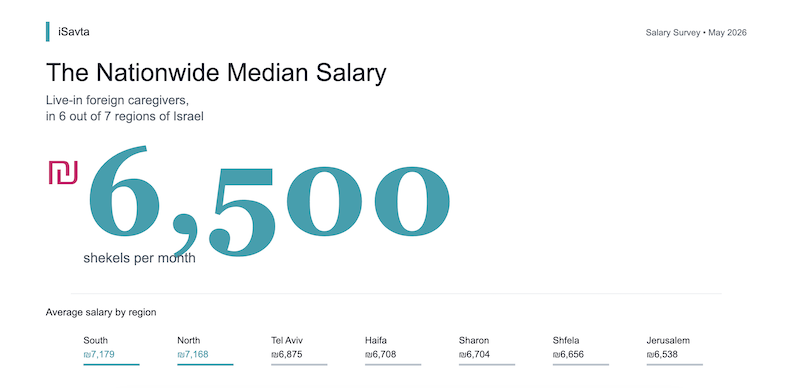
The clearest finding from the survey is that the median monthly salary offered for live-in work is ₪6,500. This is true in six out of the seven regions we checked.
What does median mean, and why does it matter more than the average? The median is the number that sits exactly in the middle. Half of all families offer less than this, and half offer more. Unlike the average, the median isn't pulled around by extreme cases. If one family offers ₪15,000 for a special situation, it drags the average up, but the median stays the same. That's why the median is a better guide to what a typical family is actually paying.
The ₪6,500 median isn't theoretical. It's the figure that appears in hundreds of active listings, more than any other number. Most jobs cluster between ₪6,200 and ₪7,000.
The Table: 7 Regions Across Israel
| Region | License Zone | Average | Median | Range |
|---|---|---|---|---|
| South | 3 | ₪7,179 | ₪6,500 | ₪5,500 – ₪12,000 |
| North | 3 | ₪7,168 | ₪6,500 | ₪5,600 – ₪15,000 |
| Tel Aviv | 1 | ₪6,875 | ₪6,500 | ₪5,500 – ₪12,000 |
| Haifa | 2 | ₪6,708 | ₪6,500 | ₪5,500 – ₪10,000 |
| Sharon | 2 | ₪6,704 | ₪6,500 | ₪5,500 – ₪9,000 |
| Shfela | 2 | ₪6,656 | ₪6,500 | ₪5,500 – ₪10,000 |
| Jerusalem | 2 | ₪6,538 | ₪6,442 | ₪5,700 – ₪9,000 |
The national weighted average is ₪6,829 per month.
The Big Story: The North and South Pay More Than the Center
The most surprising finding in the survey is that the highest-paying regions are the periphery, not Tel Aviv. This is the opposite of normal economic logic, where salary follows the cost of living. The reason both regions pay more is the same: the war.
In the North, communities that were within rocket range of Hezbollah are paying significantly higher salaries. In Tiberias, Kiryat Shmona, Mi'ilya, and Yokne'am you'll see listings from ₪8,500 to ₪10,000 per month, and in Safed one listing even reached ₪15,000. The South tells the same story. In the Gaza envelope and other rocket-range cities like Ashdod, Ashkelon, Sderot, Be'er Sheva, and Eilat, salaries of ₪7,000 to ₪9,000 per month are no longer unusual.
The average difference between the war-affected regions and the center is about ₪480 per month. Annually, that's roughly ₪5,750 more in your pocket. If you're flexible about location and able to work in the North or South, this is a real opportunity. Families there are paying a premium because caregivers are reasonably cautious about these areas, which means your willingness to work there has serious value in the market.
A few things to consider before you accept a position in these regions: ask what the security situation has been recently in the specific town, whether the family has a safe room (ממ"ד) in the home, and what the protocol is during alerts. A serious family will respect these questions and answer them clearly.
What to Know About Each Region
Tel Aviv pays a bit more than the rest of central Israel, but not by much. The gap between Tel Aviv and Haifa or Sharon is only about ₪170 a month, less than 3%. What Tel Aviv does have is a thicker upper tail, meaning more families with bigger budgets offering ₪8,000 or more. If you're aiming for a higher-end position, Tel Aviv is where these jobs concentrate.
Jerusalem has the lowest average (₪6,538) and the narrowest range. There are almost no listings above ₪7,500. This may reflect different family expectations or lower disposable income. If you're looking specifically for higher pay, Jerusalem won't be the right market.
Haifa, Sharon, and Shfela are nearly identical, all clustered around ₪6,700 average with ₪6,500 median. These are stable, predictable markets. You know what to expect.
What to Do With This Data
If you're evaluating a job offer, here's how to use these numbers:
- An offer below ₪6,000 in any region is below market. Even in Jerusalem the typical offer is ₪6,400 or more. Don't be afraid to negotiate.
- An offer of ₪6,500 is fair across most of Israel. This is the going rate.
- In the North or South, you should be offered at least ₪6,800, often more. If you're considering a job in these regions and the salary is at the central-Israel level, the family is underpaying for the situation. Ask for more.
- Salary isn't the whole picture. Make sure you understand what's included: a private room, food, time off, medical insurance, and how the family handles holidays and home leave. A slightly lower salary with a family that treats you well and pays your insurance correctly can be a better deal than a higher salary with chaos.
Why Direct Employment Matters for You
A note that's worth understanding. When you work for a family through direct employment (העסקה ישירה) instead of through a nursing agency (חברת סיעוד), the family receives the government care allowance (גמלת סיעוד) directly. This means more money in their pocket each month, which often translates to a better and more stable salary for you. Families on direct employment also tend to be more invested in the working relationship because they're managing it themselves, not through an intermediary.
If you're considering a new position, looking for one with a family on direct employment is generally a good sign.
A Note on the Numbers
The data is based on what families post in their job listings, not necessarily what they end up paying after negotiation. In many cases the final salary is higher than the listed one, especially if you have experience, references, or specialized skills (mobility-impaired care, dementia care, Hebrew language, etc.). Listings under ₪5,500 were excluded from the analysis, as well as listings with obvious data errors.
The market is yours to negotiate. Now you know the numbers.
For all the jobs click here:
https://www.isavta.co.il/en/jobs